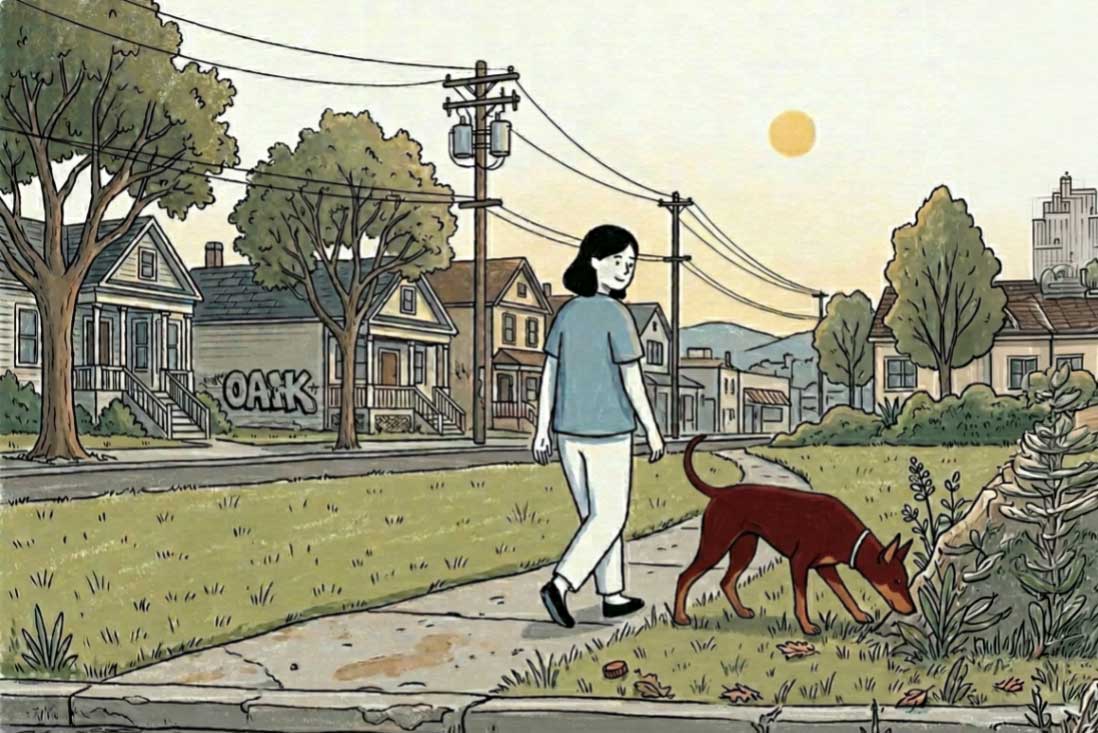
Birdie, my rescue Doberman, has two speeds: slow and slower. She doesn’t “do” speed unless it involves eating. On walks, she’s a stroller, determined to sniff every piece of greenery. She doesn’t operate on a schedule involving meetings, app alerts, or emails. Her walks are her connection to the world, and she has all the time in the world for it.
I am the opposite. If I’m at point A and need to get to point B, I try to get there as fast as possible. I like going fast. I like being productive.
For longer than I care to admit, Birdie and I were not aligned on our approach to walks. For Birdie, it’s not about getting from point A to point B, but about the journey and all the various scents along the way. For more days than I cared to count, the walk was another task to get done so I could move on to the next one.
Curiously, on days with a lot of meetings and few breaks, Birdie seemed to pick up the vibe that she must walk even more slowly. And if she spotted a cat or a squirrel, she’d put on her brakes, dig in her paws, and shut the whole walking operation down. For a fixated Doberman, there’s no such thing as coaxing, bribing, or threats (and at 80 pounds, there’s no picking her up and moving on).
Why slowing down actually makes you more productive
But much like a complicated project, sometimes you’ve got to take a step back to get your bearings and rethink your approach. You slow down to speed up again. It occurred to me one day—because sometimes I am the slow one and not on purpose—that maybe I needed to stop thinking fast and start walking slow. It worked.
These days, Birdie and I have an understanding. If she’s determined to stop and sniff, I drop the leash and let her. I walk ahead with the other dog, and she always comes along. As strong as the pull to sniff is, she never wants to be left behind. And when she walks unshackled, she walks faster.
The hidden value of intentionality over hustle
Birdie has inspired me to be more deliberate about changing my speed. When I have a big deliverable in front of me, sometimes it’s not speed that will help me but slowing down to think strategically and take a deliberate approach. I pay attention to details I might otherwise miss and connect dots I didn’t see before.
This is a work in progress, but Birdie is a big inspiration on the power of moving slowly, and I’m grateful to her for this lesson.
Epilogue: I wrote the bones of this post a few weeks ago as a sort of living tribute to Birdie, not knowing that my time with her was getting shorter. A week ago, my husband and I helped her cross the Rainbow Bridge. She isn’t in my office every day anymore, but I still feel her. And she’s still reminding me to slow down.
Gabi Barragan – Consulting Manager