Every card reader now seems to open with the same “quick question”: 18% minimum, and would you like to go higher? For customers already stretched by rising prices, the escalating tipping prompt has started to feel less like a courtesy and more like an extra tax — arbitrary and increasingly hard to justify.
But a few local spots near me are quietly breaking from the pack, and it’s working.
Take my most-recommended lunch spot in downtown Vancouver: a small shawarma truck. It’s not even my favourite food in the city. What gets me there — and what gets me talking about it — is that a $9 meal comes with a 5% minimum tip suggestion. So, I tip their suggested max 15%. Every time. Not because the dollar amount matters so much as the principle does. In other takeaway spots, asking for a bigger percentage on food that’s gotten smaller and pricier, it can feel insulting to a lot of people right now. Businesses willing to opt out of that race to the top — to keep their ask grounded — stand to gain more than they give up. And every time cost of living or tipping comes up in conversation, I bring up that truck, unprompted, just to make the point.
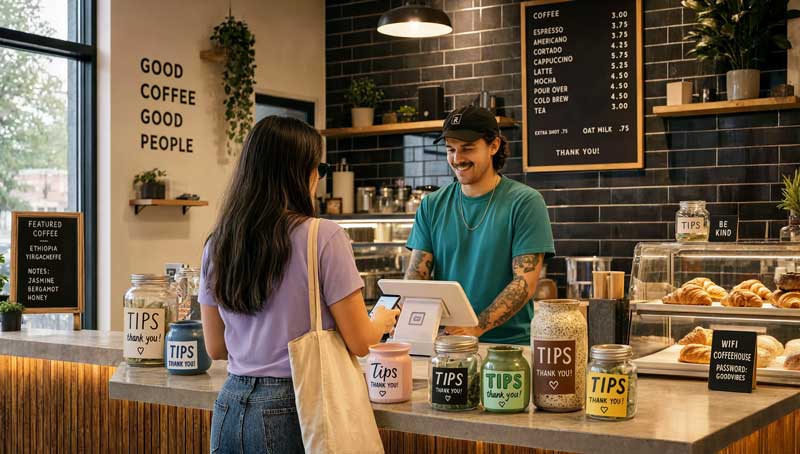
The same shift is happening in coffee. About two years ago, a new independent shop opened in the city and partnered with local media to lead with one headline: no tipping. Not the beans, not the ambiance, not anything else about the product — the tipping policy was the pitch. The coffee’s genuinely good, the space is well done, and the checkout has no “quick question” moment at the end. Since then, other new shops have followed the same playbook, and no-tipping is starting to feel less like a novelty and more like a norm among independent shops. It’s also made me more confident testing the theory in traditional chain cafés: if I’m standing at the counter to order, can I just skip the tip screen entirely?
All of this is playing out against the same backdrop: rising cost of living, and everyone — consumers and businesses alike — trying to hold onto their own dollars. But lower tipping minimums, or no tipping at all, are doing something bigger than saving people a few dollars. They’re an easy, visible way of saying “we hear you.” The businesses making this bet understand that inflation — on essentials and on small treats like a latte — is one of the sharpest pain points customers are feeling right now. And they’re betting that customers will reward that recognition with loyalty.
We talk constantly about knowing your customer’s real pain points — what’s actually keeping them up at night. But knowing isn’t the differentiator. Acting on it before you’re asked, instead of performing it after the fact, is what turns a customer into a promoter.
Kaila Joynes – Senior Consulting Manager